Password Entropy Explained: The Math Behind Brute-Force Defense and Diceware Passphrases
Learn how password entropy is calculated, how brute-force search spaces scale exponentially, and why Diceware passphrases beat complex short strings.
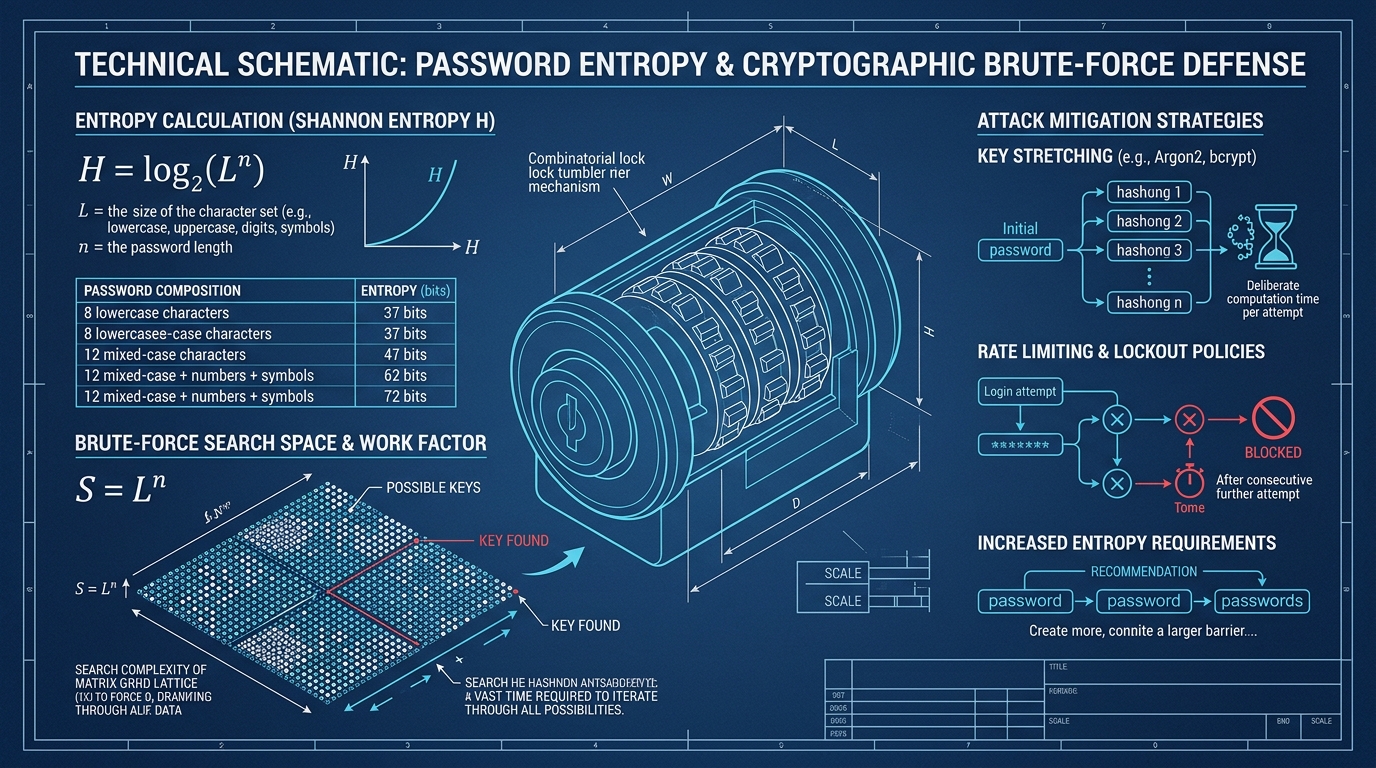
Most users are told that a secure password requires eight characters, one uppercase letter, one number, and an exclamation point. Yet modern GPU hash clusters can crack an 8-character password matching standard complexity rules in under an hour.
The security of a secret does not come from arbitrary punctuation rules. It comes from mathematical entropy—the measurement of unpredictability quantified in bits.
In this guide, you will learn how information entropy applies to passwords, how brute-force search spaces scale exponentially, why Diceware passphrases outperform random character strings, and how to calculate password strength in code.
💡 Key Takeaways#
- Entropy Formula: Password entropy is calculated as
E = L * log2(R), whereLis length andRis the size of the character pool. - Exponential Search Space: Every character added to a password multiplies the search space by
R. Length provides exponentially greater defense than character pool size. - The 8-Character Myth: An 8-character mixed password has roughly 53 bits of entropy. On a modern hash cracking cluster, it falls in minutes.
- Diceware Efficiency: Combining 5 random dictionary words creates over 64 bits of entropy that humans can actually remember and type accurately.
- Slow Hashing Protection: Entropy protects the secret, but memory-hard key derivation functions like Argon2id and bcrypt protect against offline dictionary attacks.
1. What Is Password Entropy?#
In information theory, Claude Shannon defined entropy as the average amount of information produced by a stochastic source of data. When applied to passwords, entropy represents the number of guesses an attacker must make in the worst-case brute-force scenario, expressed as powers of two ($2^E$).
The Pool Size ($R$)#
The pool size $R$ represents the total number of distinct characters available to choose from:
| Character Set | Pool Size ($R$) | Bits per Character ($\log_2 R$) |
|---|---|---|
Numbers only (0-9) | 10 | 3.32 bits |
Lowercase only (a-z) | 26 | 4.70 bits |
Mixed case (a-z, A-Z) | 52 | 5.70 bits |
Alphanumeric (a-z, A-Z, 0-9) | 62 | 5.95 bits |
Full Printable ASCII (a-z, A-Z, 0-9, symbols) | 94 | 6.55 bits |
If you create an 8-character password using alphanumeric characters:
E = 8 * log2(62) = 8 * 5.954 = 47.6 bits
Search Space = 62^8 = 218,340,105,584,896 possible combinations
While 218 trillion looks like a huge number, modern hashcat clusters running eight RTX 4090 GPUs can calculate over 100 billion NTLM or MD5 hashes per second. That entire search space can be exhausted in less than 35 minutes.
2. Length vs Complexity: The Combinatorial Math#
Many legacy corporate password policies force users to combine lowercase, uppercase, numbers, and symbols within short strings (like 8 to 10 characters). This encourages predictable substitutions (like replacing E with 3 or ending with !), which attackers account for using rule-based mask attacks.
Let us compare increasing character pool size versus increasing length:
Notice that 16 lowercase letters provides 7 million times more security than 8 characters using every symbol on your keyboard.
Length is in the exponent (R^L), while character variety is the base. Increasing the exponent always wins against brute force.
3. Diceware Passphrases: Human Memory Meets High Entropy#
In 1995, Arnold Reinhold developed the Diceware method. Instead of selecting individual characters, you roll physical dice to select whole words from a numbered list of 7,776 common words ($6^5 = 7,776$).
Because each word is drawn independently from a pool of 7,776 words:
Bits per word = log2(7776) = 12.925 bits
4 Words: 4 * 12.925 = 51.7 bits
5 Words: 5 * 12.925 = 64.6 bits
6 Words: 6 * 12.925 = 77.5 bits
A 5-word Diceware passphrase has over 64 bits of true entropy, requires zero confusing symbol substitutions, and is easy to memorize and type on mobile touchscreens without errors.
4. Calculating Entropy in TypeScript#
Here is a clean implementation showing how to calculate theoretical entropy and estimate brute-force cracking resistance for any input string:
export interface EntropyResult {
  entropyBits: number;
  poolSize: number;
  combinations: bigint;
  strengthCategory: 'Very Weak' | 'Weak' | 'Moderate' | 'Strong' | 'Very Strong';
}

export function calculatePasswordEntropy(password: string): EntropyResult {
  if (!password) {
    return { entropyBits: 0, poolSize: 0, combinations: 0n, strengthCategory: 'Very Weak' };
  }

  let poolSize = 0;
  if (/[a-z]/.test(password)) poolSize += 26;
  if (/[A-Z]/.test(password)) poolSize += 26;
  if (/[0-9]/.test(password)) poolSize += 10;
  if (/[^a-zA-Z0-9]/.test(password)) poolSize += 32;

  // Fallback if unusual unicode characters are used
  if (poolSize === 0) poolSize = 256;

  const length = password.length;
  const entropyBits = length * Math.log2(poolSize);
  const combinations = BigInt(poolSize) ** BigInt(length);

  let strengthCategory: EntropyResult['strengthCategory'];
  if (entropyBits < 40) {
    strengthCategory = 'Very Weak';
  } else if (entropyBits < 60) {
    strengthCategory = 'Weak';
  } else if (entropyBits < 80) {
    strengthCategory = 'Moderate';
  } else if (entropyBits < 100) {
    strengthCategory = 'Strong';
  } else {
    strengthCategory = 'Very Strong';
  }

  return {
    entropyBits: Math.round(entropyBits * 10) / 10,
    poolSize,
    combinations,
    strengthCategory,
  };
}

// Example usage:
const sample = calculatePasswordEntropy("correct-horse-battery-staple");
console.log(`Entropy: ${sample.entropyBits} bits (${sample.strengthCategory})`);
// Output: Entropy: 172.9 bits (Very Strong)
5. Offline Cracking vs Online Rate Limiting#
There are two completely different attack vectors against passwords:
-
Online Attacks (Targeting a Web Login Form):
- The attacker submits credentials over HTTP to an authentication endpoint.
- Attack rate is constrained by network latency, API rate limiters, CAPTCHA, and account lockout policies (e.g. 5 attempts per minute).
- Even 40 bits of entropy is effectively uncrackable online when protected by account lockouts.
-
Offline Attacks (Targeting Leaked Database Dumps):
- An attacker extracts the password hash table from a breached database and cracks hashes locally using dedicated GPU rigs.
- Attack rate is determined solely by hardware speed and the hashing algorithm used.
- Fast hashes (
MD5,SHA-1,SHA-256) allow hundreds of billions of guesses per second. - Slow, memory-hard key derivation functions (
Argon2id,bcrypt,scrypt) force the attacker to consume memory and compute cycles on every guess, reducing cracking speeds to hundreds of attempts per second.
6. Interactive Developer Tool: Test & Generate Secure Passwords#
Need to generate high-entropy random keys, Diceware passphrases, or calculate real-time bit strength for your credentials?
You can test passwords and generate cryptographically secure passphrases instantly right inside your browser:
👉 Try the Interactive Password & Passphrase Generator
The tool operates 100% client-side using crypto.getRandomValues()—secrets are never sent over the network or saved anywhere.
Conclusion: The 2026 Authentication Standard#
Modern identity security follows the NIST SP 800-63B guidelines:
- Stop enforcing arbitrary character rotation rules that degrade user behavior.
- Mandate minimum lengths of 15+ characters or multi-word Diceware passphrases.
- Check passwords against known breach databases (e.g. HaveIBeenPwned) on registration.
- Always hash stored credentials with Argon2id or modern bcrypt cost factors.
Joey Jazwinski
Hi, I'm Joey — a software engineer building modern applications, exploring artificial intelligence, and sharing my journey through code. 🚀
Recommended Articles
View all posts →
How Diff Algorithms Work: Myers Diff, Shortest Edit Script (SES), and Text Comparison Guide
Master the mechanics behind git diff and text comparison. Learn the Myers diff algorithm, Longest Common Subsequence (LCS), Shortest Edit Scripts, and compare code in real-time.

Mastering Cron Expressions: Syntax Standards, Distributed Schedulers, and Visual Guide
Master Unix and modern Cron expressions from first principles. Understand the 5-field and 6-field formats, timezones, distributed locking with Redis, and debug schedules in real-time.

Demystifying Regular Expressions: Engine Internals, Catastrophic Backtracking, and Testing Guide
Master Regular Expressions (RegEx) from first principles. Understand NFA vs DFA finite automata, prevent catastrophic backtracking (ReDoS), and test patterns in real-time.