Demystifying MongoDB Connection Strings: URI Parameters, Replica Sets, and TLS
A complete engineering guide to MongoDB connection URIs. Learn DNS SRV lookups, replica set topology discovery, write concerns, pool sizing, and TLS options.
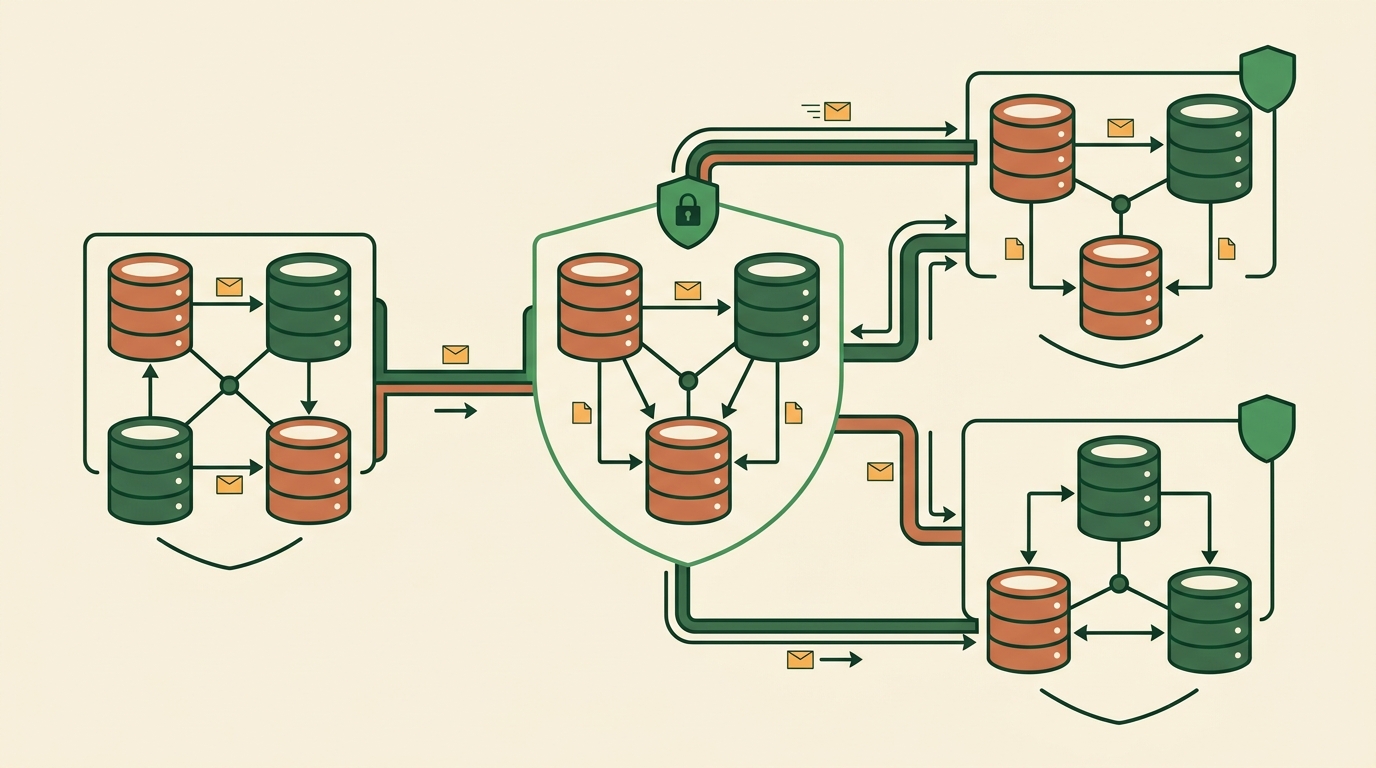
Connecting to a database seems straightforward until a replica set election occurs, an SSL handshake fails, or an unescaped character in a password breaks the connection string.
A MongoDB connection string is more than an address. It encodes driver routing topology, socket pooling limits, failover rules, and write durability guarantees into a single URI.
In this guide, you will examine the internal mechanics of MongoDB connection URIs: how DNS SRV records replace hardcoded hostnames, how write concerns affect transaction safety, and how to configure client pools for production traffic.
Key Takeaways#
- The SRV Protocol:
mongodb+srv://queries DNS SRV records to discover replica set members dynamically. It also retrieves TXT records for default configuration options liketls=trueandauthSource=admin. - Credential Encoding: Special characters like
@,:,/,?, and#inside database passwords must be percent-encoded (%40,%3A,%2F) to prevent URI parser failures. - Replica Set Member Discovery: When drivers connect to any seed node listed in the URI, they run an
isMaster(orhello) handshake. This returns the full current list of active primary and secondary members. - Write Concern Durability: Setting
w=majority&wtimeoutMS=5000prevents silent data loss during node failovers by requiring acknowledgment from a majority of voting replica members. - Connection Pooling: Defaults like
maxPoolSize=100can overwhelm database instances when running serverless functions on AWS Lambda or Vercel. These environments benefit from smaller pools and connection reuse. - Read Preferences: Options like
primaryPreferredorsecondaryPreferredroute analytical queries away from the primary node to keep write latency low.
1. Protocol Architecture: Standard mongodb:// vs mongodb+srv://#
MongoDB supports two distinct URI schemes. Understanding how each resolves network endpoints is crucial for maintaining uptime during infrastructure changes.
The Standard Connection String (mongodb://)#
A standard connection string lists each seed host and port explicitly:
mongodb://dbuser:mypassword@db1.internal.net:27017,db2.internal.net:27017,db3.internal.net:27017/production?replicaSet=myReplSet&authSource=admin
This format works anywhere, including local Docker networks and on-premise clusters. However, adding or decommissioning physical database servers requires updating the connection string across every application deployment.
The Seedlist Connection String (mongodb+srv://)#
MongoDB introduced the +srv protocol to eliminate static host lists. When your driver sees mongodb+srv://cluster.example.com, it executes two DNS lookups:
- SRV Record Lookup (
_mongodb._tcp.cluster.example.com): Returns the hostnames and port numbers for all current cluster members. - TXT Record Lookup (
cluster.example.com): Returns URI configuration parameters stored directly in DNS.
The driver enforces two security rules when parsing mongodb+srv://:
- TLS/SSL is turned on automatically unless explicitly disabled.
- All discovered hostnames must share the parent domain of the original SRV record (
example.mongodb.net). This prevents malicious DNS responses from redirecting traffic to rogue servers.
2. Anatomy of a MongoDB Connection URI#
A MongoDB URI contains distinct syntactic segments:
mongodb+srv://[username:password@]host[/[database][?options]]
Credential Percent-Encoding#
The URI parser relies on characters like @ to separate credentials from the host, and : to separate the username from the password. If a password contains an @ symbol or a slash, standard parsing fails immediately.
Always percent-encode special characters in usernames and passwords:
| Character | URL-Encoded Value | Example Raw Character |
|---|---|---|
@ | %40 | p@ssword -> p%40ssword |
: | %3A | db:pass -> db%3Apass |
/ | %2F | secret/key -> secret%2Fkey |
? | %3F | what?now -> what%3Fnow |
# | %23 | hash#tag -> hash%23tag |
% | %25 | 100%safe -> 100%25safe |
3. High Availability and Topology: Replica Sets and Read Preferences#
In a MongoDB replica set, one member is elected PRIMARY to accept write operations, while other members act as SECONDARY nodes replicating data asynchronously via the oplog.
Replica Set Parameter (replicaSet)#
When using the standard mongodb:// protocol, specifying replicaSet=rsName triggers automatic topology discovery.
Without this flag, the driver treats the address as a standalone server. If that specific machine restarts or changes roles, your application drops connections instead of discovering the newly elected primary.
Read Preference Modes#
You can control where read operations land using the readPreference parameter:
primary: Default. All reads go to the current primary node. Guarantees read-your-own-writes consistency.primaryPreferred: Reads route to the primary if available. If the primary is undergoing failover, reads fall back to a secondary.secondary: Reads only hit secondary members. Writes will fail if you run them against this handle.secondaryPreferred: Reads prioritize secondaries to distribute read query pressure, falling back to the primary if secondaries are unreachable.nearest: Reads go to the node with the lowest network ping time, regardless of whether it is primary or secondary.
Example configuration:
mongodb://db1.example.com:27017,db2.example.com:27017/?replicaSet=rs0&readPreference=secondaryPreferred&maxStalenessSeconds=90
The maxStalenessSeconds parameter prevents your application from reading stale data from a secondary that has fallen too far behind the primary oplog.
4. Write Durability: Write Concerns and Retryable Writes#
In distributed systems, committing a write to memory on one node does not mean your data is safe from unexpected hardware crashes. MongoDB provides fine-grained control over durability directly within the connection string.
Write Concern (w) and Timeout (wtimeoutMS)#
The w parameter defines how many nodes must acknowledge a write before the driver considers the operation complete:
mongodb+srv://cluster.example.net/app?w=majority&wtimeoutMS=5000
w=1: Default in older versions. The primary acknowledges the write as soon as it updates its in-memory working set. If the primary crashes before replicating to secondaries, the write is lost during election.w=majority: Modern production standard. The primary waits until a majority of voting replica set members have written the change to their journals.wtimeoutMS: Specifies an upper bound (e.g. 5000ms) to wait for replication. Without a timeout, a network partition can cause client threads to hang indefinitely waiting for offline nodes.
Retryable Writes (retryWrites=true)#
Transient network hiccups can sever a TCP socket while a write is in flight. With retryWrites=true enabled, MongoDB attaches a unique transaction identifier to the command.
If the driver loses the socket, it retries the write exactly once against the newly elected primary. If the original primary already committed the write before failing, the new primary recognizes the transaction ID and avoids inserting duplicate documents.
5. Client Sizing: Connection Pool Configuration#
Every open connection to MongoDB consumes memory on the server for socket buffers, query tracking, and TLS context. Misconfiguring pool sizes is a leading cause of database performance degradation.
| Option | Default | Production Guideline |
|---|---|---|
maxPoolSize | 100 | Set between 20 and 50 for persistent web servers; reduce to 2 to 5 for serverless functions. |
minPoolSize | 0 | Keep at 5 to 10 on long-running servers to avoid cold-start connection latency. |
maxIdleTimeMS | 0 (unlimited) | Set to 60000 (60s) to reclaim inactive sockets and avoid firewall timeout drops. |
connectTimeoutMS | 30000 (30s) | Set to 5000 to 10000ms so failed boots fail fast rather than hanging server startup. |
socketTimeoutMS | 0 (unlimited) | Set to 30000 (30s) to prevent runaway unindexed queries from holding sockets open. |
waitQueueTimeoutMS | 0 (unlimited) | Set to 5000ms so requests fail cleanly with HTTP 503 instead of queuing infinitely. |
In serverless runtimes like AWS Lambda or Next.js edge environments, avoid leaving maxPoolSize at 100. If 200 concurrent serverless invocations spin up, they attempt to open 20,000 connections simultaneously, immediately exhausting database connection limits.
6. TLS / SSL Security Configuration#
Connecting across public cloud providers or untrusted networks requires TLS encryption.
mongodb://db.internal.net:27017/app?tls=true&tlsCAFile=%2Fetc%2Fssl%2Fcerts%2Fca.pem&tlsCertificateKeyFile=%2Fetc%2Fssl%2Fclient.pem
Key security parameters include:
tls=true: Enforces TLS encryption for all transport sockets.tlsCAFile: Path to the Certificate Authority file used to validate the database server certificate.tlsCertificateKeyFile: Path to the client certificate and private key when using x.509 mutual authentication (mTLS).tlsAllowInvalidCertificates=false: Never set this totruein production. Bypassing certificate checks disables man-in-the-middle protections.
7. Connecting in Node.js and TypeScript#
Here is a clean implementation configuring connection pooling, timeout fallbacks, and write concerns using TypeScript and the native MongoDB driver:
import { MongoClient, MongoClientOptions } from 'mongodb';

export function buildDatabaseClient(uri: string): MongoClient {
  const options: MongoClientOptions = {
    // Keep connection pools reasonable for high-throughput microservices
    maxPoolSize: 50,
    minPoolSize: 5,

    // Fail fast if the primary cannot be contacted
    serverSelectionTimeoutMS: 5000,
    connectTimeoutMS: 10000,
    socketTimeoutMS: 45000,

    // Close connections that sit idle for more than a minute
    maxIdleTimeMS: 60000,

    // Durability defaults
    retryWrites: true,
    writeConcern: {
      w: 'majority',
      wtimeoutMS: 5000,
    },
  };

  const client = new MongoClient(uri, options);

  // Monitor cluster topology events
  client.on('serverDescriptionChanged', (event) => {
    console.log(`[MongoDB] Topology changed: ${event.address} is now ${event.newDescription.type}`);
  });

  return client;
}

// Example usage:
const connectionString = process.env.MONGODB_URI;
if (!connectionString) {
  throw new Error('MONGODB_URI environment variable is missing.');
}

const dbClient = buildDatabaseClient(connectionString);
8. Interactive Developer Tool: Build and Test MongoDB URIs#
Need to build a custom MongoDB connection string, encode passwords safely, or toggle between standard hostnames and mongodb+srv://?
Build, test, and format your connection strings client-side without sending sensitive credentials across the network:
👉 Try the Interactive MongoDB URI Builder
The tool runs completely in your browser memory and formats connection strings for MongoDB Atlas, self-hosted replica sets, and local development instances.
Production Checklist#
Follow these concrete checks before releasing a database connection string into production:
- Percent-encode all credentials: Ensure special characters like
@or:in generated passwords do not break URI syntax. - Always define write timeouts: Pair
w=majoritywithwtimeoutMS=5000to prevent socket hangs during node failover. - Right-size connection pools: Reduce
maxPoolSizeto 5 or 10 on serverless compute layers to protect database memory. - Explicitly set
authSource: When using custom administrative databases or role-based users, specifyauthSource=admin. - Verify TLS validation: Keep
tlsAllowInvalidCertificatesdisabled and provision valid certificates for all replica members. - Set server selection timeouts: Lower
serverSelectionTimeoutMSfrom 30 seconds to 5 seconds so applications fail fast during network outages.
Joey Jazwinski
Hi, I'm Joey — a software engineer building modern applications, exploring artificial intelligence, and sharing my journey through code. 🚀
Recommended Articles
View all posts →
How QR Codes Work Under the Hood: Reed-Solomon Error Correction, Mask Patterns, and Matrix Encodings
Explore the computer science and math behind Quick Response codes. Learn 1:1:3:1:1 finder patterns, Galois field error correction, mask formulas, and URI schemes.

Runtime Type Validation in TypeScript: Zod Architecture, Static Type Inference, and API Boundary Defense
Master runtime validation in TypeScript. Learn how Zod executes schema parsing, derives static types with z.infer, and protects API boundaries against invalid input.

Cryptographic Hash Functions Explained: SHA-256, Merkle-Damgård Construction, and Collision Resistance
Learn how cryptographic hash functions work under the hood. Explore SHA-256, Merkle-Damgård block processing, the avalanche effect, and HMAC integrity.